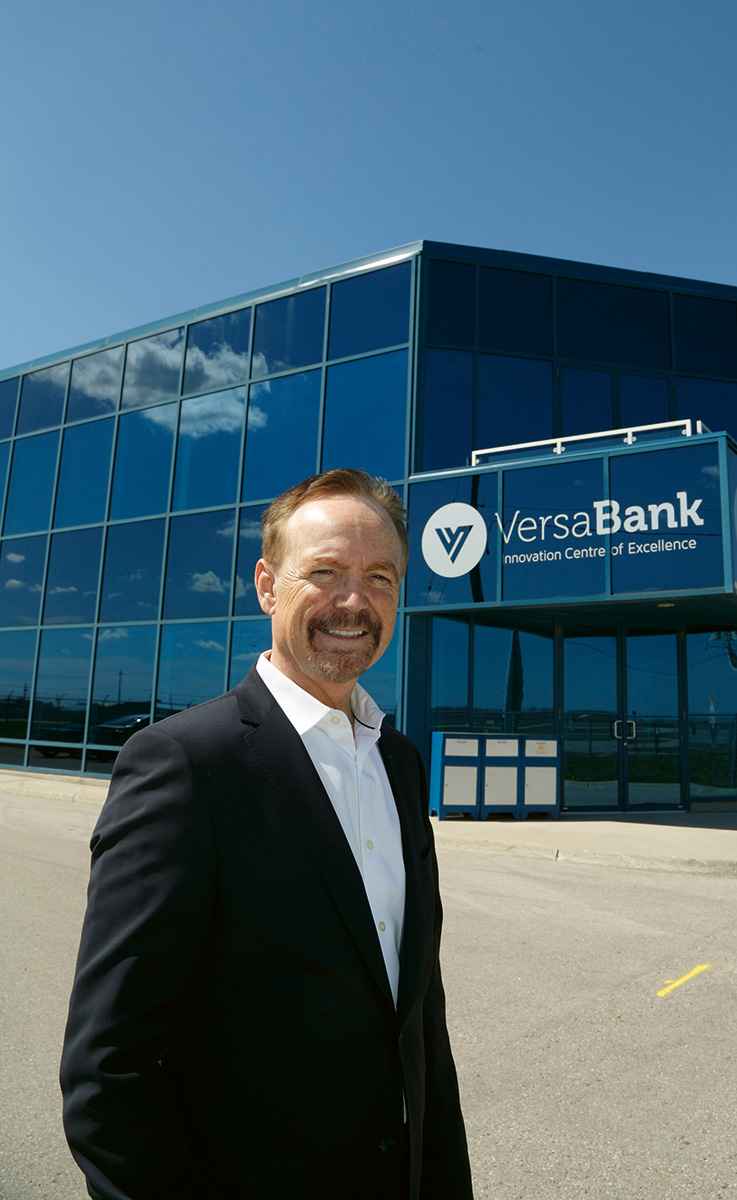

“Our mission is to provide innovative, digitally based solutions to markets that are overlooked or not well served by the traditional large financial institutions,” says David Taylor, founder and President of VersaBank.
Headquartered in London, Ontario, Canada, VersaBank’s mission goes back more than three decades, when Taylor resolved to deliver massive innovation in the North American banking market by launching a digital bank without physical branches. He combined his expertise gained from working for the Bank of Montreal and Barclays with computer programming skills to pioneer the first fully digital, branchless business-to-business bank.
Taylor describes what he was doing as “sacrilege”, as it confounded the conventional thinking that a bank was the sum of its branches, and that no institution had a distribution channel other than through physical locations. Unsurprisingly, the implementation of a branchless bank faced scepticism from the banking and financial regulatory communities. So, to demonstrate that his concept was viable, in 1993 he bought Pacific & Western Trust –the tiniest financial institution he could find – which was based in the city of Saskatoon in the province of Saskatchewan (where one of the bank’s two technology centres still resides, at the University of Saskatchewan’s Innovation Place Research Park). Taylor then transformed it into a prototype “branchless” financial institution, so the regulators could see a working model of what he had in mind. To further help financial markets and regulators understand and accept the new model, Taylor went province by province in Canada and incorporated his new branchless trust company in each of those provinces, “creating a groundswell of acceptance”.
After nearly a decade of successfully proving the branchless model, VersaBank per se came into existence as a federal bank in Canada on 1 August 2002, with the award of a charter to become the first new federal bank in 18 years. In 2024, VersaBank received a national charter in the US, making it the first foreign bank to be granted a US national licence in around 30 years. Now, VersaBank is realigning its corporate structure (subject to regulatory and shareholder approvals), to take full advantage of its unique position serving both Canada and the US with state-of-the-art digital banking solutions. VersaBank plans to adopt the common US corporate structure with a US bank holding company called Versa Bancorp. The bank is rapidly gaining traction in the US, as its core digital banking product, the innovative Structured Receivable Program, attracts attention from some of the country’s largest point-of-sale lending companies, replicating the success of the same solutions in Canada over the past 15 years. The bank’s expansion reflects a broader industry trend towards rapid adoption of new financial technologies.
VersaBank’s core mission is to provide reliable, readily available and economically attractive funding to point-of-sale financing companies that can ultimately be accessed by end consumers and small businesses for what are typically “big ticket” purchases. As its national banking licences in both Canada and the US allow it to access inexpensive, insured deposits on both sides of the border, it has an advantage over many conventional funding sources.
Through its advanced proprietary technology platform, which enables the provision of such reliable and economically attractive funding, the bank can effectively address a high-growth, underserved market that has suffered from a lack of attention and innovation. The bank connects electronically, using its own internally developed software, with external financial intermediaries called “partners”, which handle the direct relationships with borrowers and depositors. “We strive to be the most efficient bank on the planet so our partners can provide the best financing and terms to borrowers,” says Taylor. “That’s why we must relentlessly continue to improve efficiency.”
VersaBank also uses technology to mitigate credit risk and has suffered no significant losses in its history. This further enables the bank to keep its financing costs low, supporting both its own profitability and that of its partners.
The bank has also built a custom banking package for the insolvency industry. This sector comprises accounting firms that manage the winding-up of insolvent estates. Owing to the highly regulated nature of this industry, insolvency professionals face challenges with generic banking packages, so a solution was designed specifically. Without advertising, the package was adopted quickly, saving clients significant time, effort and money. In a short time, VersaBank became the dominant player in the Canadian insolvency industry.
While VersaBank was seen as a technological anomaly in its early days, its innovations are now regarded as mainstream by both Wall Street and the Canadian financial industry. The company has benefited from being at the leading edge, even as it has accelerated over the past three decades from faxes, modems and the internet to a distributed ledger database. Now, VersaBank is launching state-of-the-art tokenised deposit solutions for banks. These Real Bank Tokenized Deposits (RBTDs) combine the safety and soundness of traditional bank deposits with the efficiency, cost savings, security and programmability of blockchain technology. As the first tokenised deposits available in both Canadian and US dollars, RBDTs enable the holders to carry out fast, low-cost foreign exchange transactions on the blockchain 24/7, 365 days a year.
In all these markets, VersaBank avoids going head-to-head with the existing players. Instead, it surveys financial markets and identifies inefficiencies in offerings and opportunities to provide a better product. The metaphor Taylor uses is coming into a transport sector dominated by horse and cart and demonstrating an automobile.
VersaBank’s contribution to Canadian communities was recognised when Taylor received the King Charles III Coronation Medal in 2025. The bank is now looking to take its model to markets in Europe such as the UK, Ireland and Iceland. “This works in these two countries, and will no doubt work just as well elsewhere,” says Taylor. “Our cloud-based model is easily scalable, so our bank services can be expanded almost infinitely throughout the world.”
Visit Site